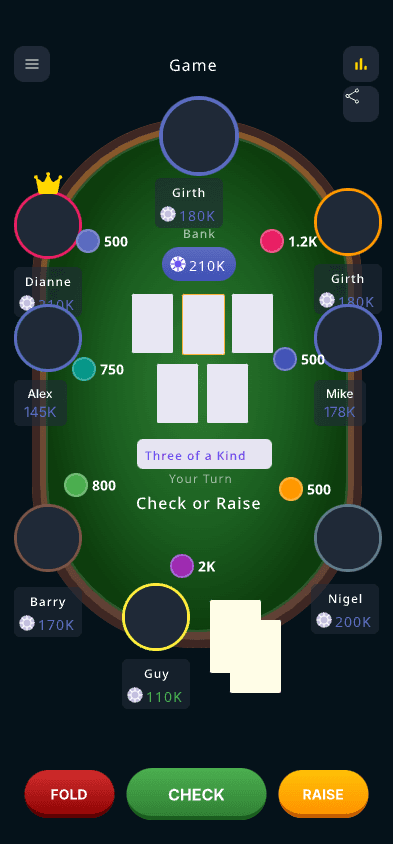
A good poker score keeper removes the spreadsheet work from a home game. PokerChip.live keeps the important numbers visible while your group focuses on the hand.
The same four nights, ranked by total profit and by profit per session. They disagree, and the disagreement is the reason it matters which one your group puts on the board.
Player
Alex
Sessions
4
Net
+215
Per session
+54
Rank by total
1st
Rank by average
2nd
Player
Chris
Sessions
1
Net
+90
Per session
+90
Rank by total
2nd
Rank by average
1st
Player
Jordan
Sessions
3
Net
−55
Per session
−18
Rank by total
3rd
Rank by average
3rd
Player
Riley
Sessions
4
Net
−250
Per session
−63
Rank by total
4th
Rank by average
4th
Player
Sessions
Net
Per session
Rank by total
Rank by average
Alex
4
+215
+54
1st
2nd
Chris
1
+90
+90
2nd
1st
Jordan
3
−55
−18
3rd
3rd
Riley
4
−250
−63
4th
4th
Replace notes and mental math
Instead of writing rebuys on paper or rebuilding the session afterward, the room keeps the running state visible throughout the game. This also captures long-tail needs like a free poker chip counter, a browser chip tracker, and a quick way to score a private poker night.
Designed for casual hosts
The setup flow uses common presets for casual, standard, and higher-stakes games, then lets hosts adjust blinds and buy-ins.
Use it for recurring poker nights
Game history and statistics make the product useful beyond a single session, especially for friend groups and private clubs.
Score the session, not the hands
A home game does not need hand-by-hand records, and groups that try to keep them stop by the second night. What a score keeper needs is the four numbers that bound a session — who played, what they bought in for, what they rebought, and what they left with. Everything a leaderboard can say is derived from those.
Total profit measures attendance
The player who shows up every week will top a total-profit board eventually whether or not they are the best player, and the one who came once and won will not. Per-session average answers the question people think they are asking. Show both if you like, but decide which one the standings are sorted by.
Twenty sessions before the numbers mean anything
Below that, a leaderboard is a record of who has run well recently. That is fine as entertainment and it is not a measurement, and it is worth saying out loud in a group where somebody is starting to take it personally. Poker results need a lot of sessions before skill outweighs variance.
Reset the season
Running totals since the game began stop meaning anything after a year — somebody who ran badly in the first month is still carrying it, and a new player starts impossibly far behind. A quarterly or annual reset gives the standings stakes again and gives everybody a fresh start, which is the point of a season.
The score is a social object
A leaderboard changes how a group plays, usually for the better and occasionally not. It gives regulars a reason to come back and gives a losing player a number to be unhappy about. Groups that handle this well tend to keep the standings light — a season, a trophy, a running joke — rather than treating them as a verdict.
Keep the buy-in constant across a season
Standings only compare if the sessions do. A night where everybody bought in for double is not comparable to a normal one, and averaging them together produces a leaderboard that rewards whoever happened to attend the big game. If your group varies the stake, either keep separate standings or record results in buy-ins rather than currency.
Record who did not play
It sounds pedantic and it is the difference between a standing that means something and one that does not. Sessions played is what turns a total into an average, and a player missing from a night has to be missing rather than assumed absent, otherwise the denominator is wrong for everyone.
Publish it the same day
A leaderboard that appears three days later is a leaderboard nobody looks at. The value of a score keeper is mostly social — it gives the group something to talk about between games — and that only works while the night is still fresh.
Two boards, not one
Groups that keep both a season leaderboard and an all-time one tend to argue less, because the season answers who is playing well now and the all-time answers who has been around longest. Trying to make one table do both is what produces a standing nobody agrees with.
Nobody has to be the scorekeeper
The job traditionally falls to whoever hosts, on top of dealing with the food, the chips and the door. Splitting it so each player records their own buy-ins removes the bottleneck and, as a side effect, removes the person everyone has to interrupt mid-hand to ask for a number.
FAQ
Questions about poker score keeper
01
What does a poker score keeper track?
It tracks players, buy-ins, chip stacks, pots, blinds, hand winners, and final results depending on the game flow.
02
Can I use PokerChip.live for Texas Hold'em?
Yes. PokerChip.live focuses on Texas Hold'em and common home-game workflows.
03
Can I use it without signing up?
Visitors can explore the flow and create intent quickly. Account features are used when a room needs to be saved and managed.
04
Does it calculate who won and lost?
Yes. The game result flow shows final standings based on buy-ins and final stacks.
05
Is it mobile friendly?
Yes. The room flow is built for phones because most players use it at the table.
06
What should a poker score keeper record?
Who played, buy-ins, rebuys and cash-outs. Every statistic a leaderboard can show comes from those four; hand-by-hand records are more than a home game needs.
07
Should the leaderboard use total profit or average?
Average per session. Total profit mostly ranks who has attended most often, which makes for a leaderboard about turning up rather than about poker.
08
How many sessions before the standings mean something?
Around twenty. Below that you are looking at who has run well recently, which is entertainment rather than a measurement.
Ready to run the next poker night?
Create a free room, invite players, track live stacks, and share the final result when the game ends.