Why settlement gets messy
Home games often have rebuys, partial cash-outs, and players leaving at different times. A settlement calculator turns those totals into a clean list of transfers.
Settle the night cleanly
Use this calculator when a poker session ends and everyone needs to know who pays whom. Enter each player's total buy-in and cash-out or final stack.
Minimize the number of payments
Catch buy-in and cash-out mismatches
Link directly into PokerChip.live for future games
Buy-ins and cash-outs have to sum to the same number — money does not appear at a poker table. From there, the job is to find the shortest set of payments that clears every balance.
Player
Alex
Bought in
100
Cashed out
180
Net
+80
Player
Sam
Bought in
100
Cashed out
40
Net
−60
Player
Jordan
Bought in
100
Cashed out
80
Net
−20
Player
Riley
Bought in
100
Cashed out
100
Net
0
Player
Total
Bought in
400
Cashed out
400
Net
0
Calculateur en direct
Total des caves
$400
Total encaissé
$480
Statut
Vérifiez les totaux
Paiements suggérés
Blake pays Alex $60.00
Casey pays Alex $20.00
Home games often have rebuys, partial cash-outs, and players leaving at different times. A settlement calculator turns those totals into a clean list of transfers.
Positive net results are winners. Negative net results are payers. The suggested transfers settle the whole table with fewer back-and-forth payments.
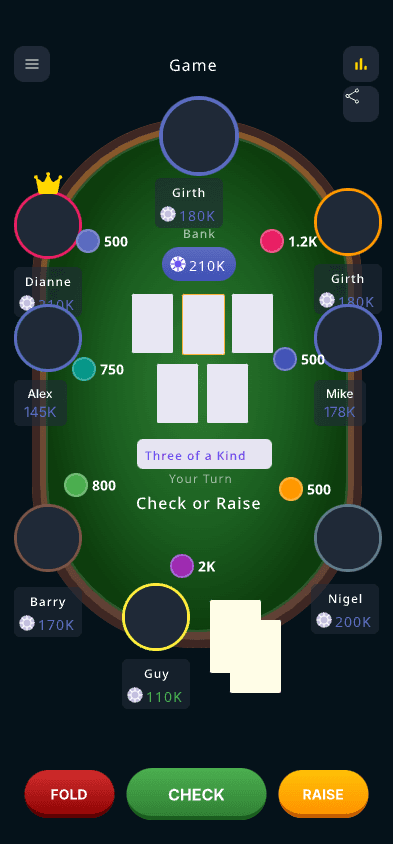
PokerChip.live records buy-ins and stacks during the session so the settlement step is easier at the end.
Every settlement that balances is equally fair; they differ only in how many payments it takes. Four players who each owe or are owed can be cleared in two transfers or in six, and six is what happens when everybody pays everybody. Matching the largest debtor to the largest creditor and working down produces the short list.
If the buy-ins and the cash-outs do not sum to the same number, the settlement cannot be right no matter how carefully it is calculated. That difference is almost always an unrecorded rebuy. Find it before you divide anything, because a settlement built on a wrong total distributes the error across everyone.
Reconstructing a night at 1am from four people's memories is where good games go wrong. Buy-ins and rebuys entered when the money changes hands take seconds; recalled at the end they take twenty minutes and produce at least one person who is fairly sure it was different.
Splitting real money produces amounts nobody can pay. Decide once whether you round to the nearest note, the nearest buy-in, or not at all, and apply it the same way every week. A rule agreed in advance stops the rounding conversation from happening every single time.
Groups that play weekly often carry balances rather than settling in cash every night, which is fine as long as the running total is written down somewhere both people can see. The version that goes wrong is the one that lives in one person's head.
The chips in front of somebody at the end are a cash-out, not a result. The result is that number minus everything they put in, and rebuys are the part people forget. Settling from what is visible on the table at 1am is how a player who rebought twice ends up looking like they had a good night.
Read the net for each player out loud before any money moves. It takes thirty seconds, it catches the error that would otherwise be discovered in a group chat the next day, and it means nobody is quietly assuming a different number while nodding.
All three work and the failure is mixing them without saying so — one player transfers, another pays cash, and the host is left holding a difference nobody agreed to. Pick one as the default for the group, allow exceptions out loud, and settle the exceptions the same night.
The person running the game usually ends up covering the odd amounts because it is easier than asking. Over a season that is a real transfer of money from the person doing the most work. Round in a fixed direction, agreed once, and it stops being anyone's problem.
A player who goes home owing money is a player somebody has to chase, and chasing is how a regular becomes a former regular. Close the ledger while everyone is still in the room, even if the payments themselves happen later.
Disputes about a previous session are unresolvable if the record only lived on somebody's phone that night. A history the whole group can open turns a vague memory of who still owes what from an argument into a lookup.
Two players sharing a pot is decided at the table and does not complicate the ledger at all — the chips move, and the settlement still only cares about what each player bought in for and what they left with. It gets confused with chopping the prize pool because both are called a split, and only one of them affects the accounting.
FAQ
01
Subtract each player's total buy-in from their final cash-out or stack value. Winners receive money and losing players pay until every net result balances.
02
Check missing rebuys, rounding, unpaid buy-ins, or a final stack that was entered incorrectly.
03
No. It only calculates and displays chip and score information. Players settle privately outside the app.
04
Yes. Settlement calculators are most useful for cash-style home games with buy-ins and cash-outs.
05
The calculator page can model larger groups, while live PokerChip.live rooms are optimized for standard home tables.
06
Work out each player's net — cash-out minus buy-in — then match the biggest debtor to the biggest creditor and work down. That produces the fewest transfers.
07
Something was recorded wrong, almost always an unrecorded rebuy. Fix it before dividing anything: a settlement built on a wrong total spreads the error across everyone.
08
Groups that play weekly often carry balances instead. That works as long as the running total is written down where both people can see it.
Create a free room, invite players, track live stacks, and share the final result when the game ends.
Create Game Room