A shared table, not a solo spreadsheet
Every player can see the same table state, which makes the tracker feel like part of the game instead of post-session bookkeeping.
Live stack tracking
PokerChip.live is a poker chip tracker for groups that want live chip counts without physical chips, spreadsheets, or one person doing all the math.
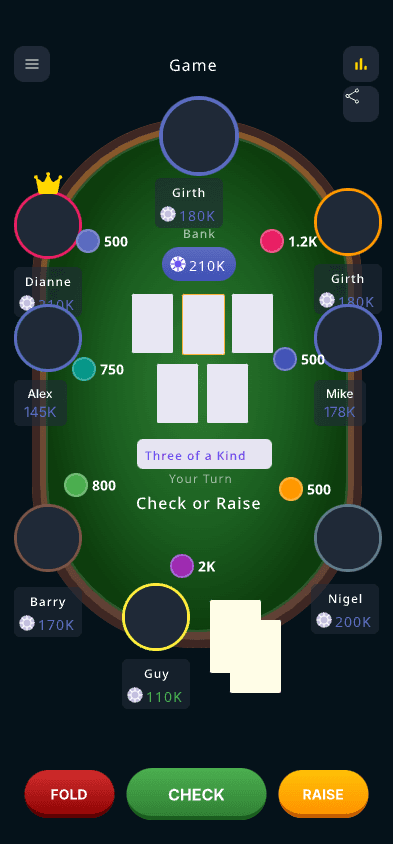
Live player stacks across devices
Room codes and QR sharing
Fast end-of-game results
A chip tracker is only as good as the moments it captures. These are all of them; everything else a tracker shows you is derived from these four.
Event
Buy-in
When it happens
As a player sits down
What it changes
Their stack, and the table total
Event
Bet or raise
When it happens
Every street
What it changes
Their stack and the pot
Event
Pot awarded
When it happens
End of a hand
What it changes
The winner's stack, pot back to zero
Event
Rebuy
When it happens
Whenever they run out
What it changes
Their stack and the table total
Event
Cash-out
When it happens
As a player leaves
What it changes
The final ledger
Every player can see the same table state, which makes the tracker feel like part of the game instead of post-session bookkeeping.
Digital tracking helps when your group has cards but not enough physical chips, or when chip denominations become confusing. It also fits searches for an online free poker chip tracker because no one needs to install a heavy app to join.
The app understands common poker actions like betting, calling, raising, folding, awarding pots, and moving to the next hand, which makes it stronger than a generic counter or spreadsheet.
The difference between a chip tracker and a chip counter is time. A counter tells you what is on the table right now; a tracker knows what each stack was an hour ago, what went into which pot, and how the current number was arrived at. That history is what settles the disagreements a counter cannot.
The failure mode of one person tracking on their own phone is that the table has to ask them for numbers. When each player can see every stack, bet sizing becomes possible again — you cannot decide whether to shove without knowing what the player behind you has behind.
They happen late, often, and while somebody is in the middle of a hand. A rebuy entered as it happens is a number; a rebuy remembered at the end of the night is an argument. Almost every home-game ledger that will not balance is missing a rebuy rather than anything more interesting.
Poker nights run for hours and phones lock, get calls, and run out of battery. Anything holding state in a browser tab loses it. Stacks that live on the server mean a player can close everything, borrow somebody else's phone, and find their seat exactly as they left it.
Almost every dispute at a home game is really about a number nobody wrote down. Keeping every stack on screen and current removes the class of argument entirely, because there is nothing left to remember differently. It is a smaller feature than it sounds and it changes the temperature of the evening more than anything else.
The number that has to be right is the sum. Buy-ins in must equal chips on the table at every moment, so if the total drifts, something was entered wrong and you can find it while the hand is still recent. A tracker that shows only individual stacks makes you notice the error at settlement, which is the worst possible time.
The arrangement that fails is everybody keeping their own note. Four private records disagree by the end of the night and there is no way to tell which is right. A single shared record that everyone can see is not a nicety — it is the only version of tracking that can settle anything.
FAQ
01
Yes. PokerChip.live tracks pot size as players act during a hand.
02
Yes. Players join with a room code or shared link from their own devices.
03
PokerChip.live includes game controls designed for real sessions where players may need to correct or recover state.
04
Yes. Rooms are meant for private home games and friend groups.
05
The result page shows final standings and shareable summaries.
06
A counter totals what is on the table now. A tracker keeps the history — what each stack was, what went into each pot, and how the current number was reached.
07
They should be able to. If only the host can see the numbers, the table has to keep asking, and bet sizing against an opponent becomes guesswork.
08
Nothing, if the stacks are on the server. The player opens the link on any device and the seat is exactly where they left it.
09
Yes. The events are the same — the difference is that rebuys usually close after a set level and the stacks stop mapping to money, so the tracker is keeping score rather than a ledger.
010
It should not. Entering a bet has to be faster than counting one out, or the table will stop doing it by the second hour — which is the real test of any tracker.
011
No, only online. Players can be on mobile data and the host on wifi; the stacks live on the server rather than being passed between phones.
012
You should be able to. Entries get mistyped mid-hand, and a tracker that cannot be corrected forces the table back to paper the first time it happens.
Create a free room, invite players, track live stacks, and share the final result when the game ends.
Create Game Room