Built for real cards
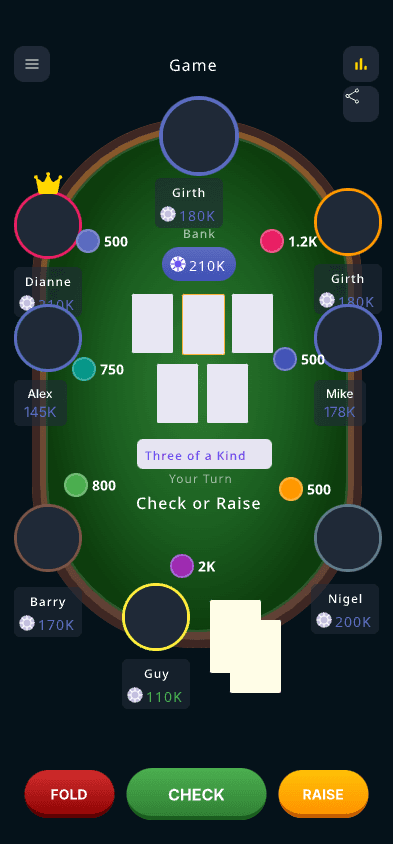
This is not a casino app or a real-money poker room. Your group deals physical cards at the table, while virtual chips handle stack counts, blinds, pots, and end-of-night results.
Free · No login · No download
Virtual poker chips — also called digital poker chips or online poker chips — solve the most common home-game problem: everyone has cards, but the chip set is missing, confusing, or too slow to count. PokerChip.live gives the table a shared chip stack on every phone while the group still plays together in person.
Replace missing or mismatched chip sets
Keep live stacks synced for every player
Settle the session without recounting piles
Both run the same game with the same cards. This is what genuinely differs, including the parts where the chips win.
Feel
Physical chips
The reason to keep them
Tracked stacks
A screen, honestly
Player limit
Physical chips
Whatever the set holds
Tracked stacks
None
Rebuys
Physical chips
Find the case, count a stack
Tracked stacks
A number, between hands
Disputed pot
Physical chips
Two recollections
Tracked stacks
One record
Settlement
Physical chips
Count, then arithmetic
Tracked stacks
Already written
Setup time
Physical chips
Sorting denominations
Tracked stacks
Share a link
Compteur de tapis
Jetons en jeu
4,000
Total des caves
$400
Chip leader
Alex
Étape suivante
Emmenez la même configuration à une table que chacun suit sur son téléphone. Les comptes sont déjà faits.
Gratuit · sans téléchargement · connexion seulement si vous organisez
This is not a casino app or a real-money poker room. Your group deals physical cards at the table, while virtual chips handle stack counts, blinds, pots, and end-of-night results.
Players join from a browser link or QR code, which makes virtual chips practical for guests who do not want to download another poker app before the first hand.
Each room keeps player stacks, pot size, blinds, and seat positions in sync across phones, tablets, and laptops, so the host does not have to act as the only scorekeeper.
Virtual chips are most useful when rebuys, all-ins, side pots, or cash-outs make physical chip counting slow and error-prone.
Online poker chips help when your group has cards but no chip set — vacations, dorms, office game nights — or when you want to skip counting and sorting chips after the game.
When the game ends, PokerChip.live records buy-ins, final stacks, and player results so the group can settle up faster and without disputes.
This is the part people expect to be different. Virtual chips do not mean playing poker on a screen — the deck is physical, the deal is physical, the tells are physical. Only the money moves to the phone, which is the part that was never fun to handle anyway. Groups who try it usually describe the game as unchanged except that nobody is counting.
Chips cannot tell you what a player's stack was an hour ago, cannot stop two people remembering a pot differently, and cannot produce a settlement at the end. A tracked stack does all three by existing. The record is the real feature: at the end of the night there is one version of what happened, and it is not anybody's recollection.
In a physical game a rebuy means finding the chip case, counting out a stack, and interrupting whoever is dealing. Tracked, it is a number somebody enters while the next hand is being shuffled. This matters more than it sounds — rebuys are the most frequent source of settlement disputes precisely because they happen at the least convenient moment.
Nine players and a set built for six is the usual reason a group looks for this. So is a set with a missing denomination, or a night where three people rebuy twice. None of those have a good physical answer; all of them are non-problems when the stacks are numbers.
Chips feel good. Stacking them, splashing a pot, the sound of a raise — a screen does not replace any of that, and some groups will not want it to. If your table enjoys the ritual, keep the chips and use a tracker only for the settlement at the end. The two are not exclusive.
One person creates a room and shares a link or holds up a QR code. Everyone else opens it and takes a seat under their own name; no accounts, no downloads. Buy-ins go in, the game runs, and when the last hand ends the ledger is already written — who is up, who is down, and the shortest list of payments that settles it.
FAQ
01
Virtual poker chips are digital stack values used to track a poker game without physical chips. Players still deal cards and play together while the app tracks chip movement.
02
Yes. PokerChip.live is designed for real-card home games where chip stacks are tracked online.
03
Players can join quickly from a shared room link. Saved history and club features may use accounts for recurring groups.
04
No. PokerChip.live tracks chips and scores only. It does not process deposits, withdrawals, wagers, or real-money gaming.
05
You can still use virtual chips for settlement, backup counts, travel games, or nights when denominations are hard to manage.
06
Yes. PokerChip.live supports common home-game flows like rebuys, joining mid-game, and cashing out when a session ends.
07
They describe the same thing. Virtual and digital emphasize replacing physical chips, while online emphasizes that the chips live in your browser. PokerChip.live covers all three: browser-based chip stacks for in-person games.
08
No. The cards stay physical and everyone is at the same table. Only the chips move to the phone, so nothing about how the game plays changes.
09
Their stack lives on the server, not on the phone. They open the link again on any device and pick up exactly where they were.
010
Yes, and plenty of groups do. Play with physical chips and enter the buy-ins and cash-outs, and the settlement is worked out for you.
011
The counter above is the whole thing — it runs in the browser tab you are already in, with no install and no account. Set the number of players and the buy-in and it returns the stack each player starts with and what the table holds in total. If you want the count to stay live while you play rather than be worked out once, open a room instead and every phone sees the same numbers.
012
A counter answers a question once: given this buy-in and this many players, how many chips does everyone get. A tracker keeps answering it for the rest of the night — every bet, pot, and rebuy moves the numbers as the game runs. Use the counter before the first hand and a room for the game itself.
013
That is the case this was built for. You need a deck and one phone per player; the chips do not have to exist. Nobody hunts for a missing denomination, and a nine-player game is no harder to run than a five-player one.
Create a free room, invite players, track live stacks, and share the final result when the game ends.
Create Game Room