For quick stack checks
Use the counter before a session, during a rebuy, or before cash-out when players need a clean chip total.
Free browser chip counter
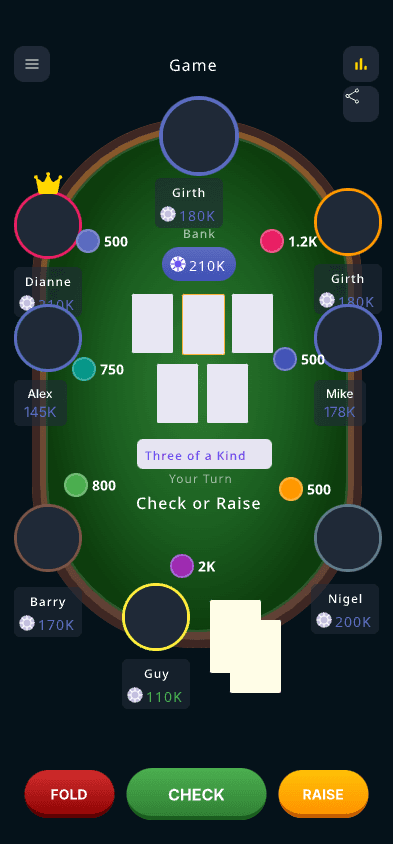
A poker chip counter is useful when the table needs fast stack math without a spreadsheet. Count each player's stack, check the table total, then move into a live PokerChip.live room when the game needs shared tracking.
Count stacks by player
Check total chips at the table
Move from quick counting to live tracking
The counter above adds up whatever you type in. This is the shape a typical starting stack takes, so you can see at a glance whether a count is plausible before you go looking for a missing chip.
Buy-in
$5
Typical stack
20x1, 6x5
Chips per player
26
Table total, 6 players
$30
Buy-in
$20
Typical stack
20x1, 8x5, 4x25
Chips per player
32
Table total, 6 players
$120
Buy-in
$50
Typical stack
20x1, 8x5, 4x25, 1x100
Chips per player
33
Table total, 6 players
$300
Buy-in
Tournament
Typical stack
8x25, 10x100, 6x500, 4x1000
Chips per player
28
Table total, 6 players
60,000
Compteur de tapis
Jetons en jeu
4,000
Total des caves
$400
Chip leader
Alex
Étape suivante
Emmenez la même configuration à une table que chacun suit sur son téléphone. Les comptes sont déjà faits.
Gratuit · sans téléchargement · connexion seulement si vous organisez
Use the counter before a session, during a rebuy, or before cash-out when players need a clean chip total.
The counter runs in the browser, so hosts can use a laptop while players verify totals from their phones. Nothing to install and nothing to sign up for.
Poker counting needs player names, stack changes, buy-ins, and a table total. A poker-specific counter keeps those values grouped around the game.
Final chip counts are easier to settle when every player has a visible stack total and the table total is easy to compare against total buy-ins.
When everyone needs to see the same state, create a PokerChip.live room and let each player join from their phone.
Chips are stacked in columns of twenty in a cardroom for exactly this reason: you count columns, not chips. At home the columns are whatever height people feel like, so the fast method is to count by colour instead — how many black, how many green, how many red — and multiply. That is what the counter above is doing, and it is why entering counts per colour is quicker than trying to total a pile in your head.
Individual stacks drift all night and nobody minds. The number that has to be right is the total on the table, because it should equal the money that went in. If the table total does not match the buy-ins, a chip has gone under a chair or somebody has been paid twice, and finding out at 1am with the money already split is much worse than finding out at the next break.
The moment to check is while everyone is still sitting down and nobody has started stacking to leave. Once chips start moving into pockets and colours get mixed into one pile, reconstructing who had what becomes a conversation rather than an arithmetic problem. A thirty-second count at the second-to-last hand prevents almost every settlement argument.
It is almost never theft and almost always a chip on the floor, a rebuy nobody wrote down, or a pot that was split badly three hours ago. Check the rebuys first — that is the usual answer. If the number still will not reconcile, the fair fix is to divide the shortfall across the players in proportion to their cash-out rather than pin it on whoever is easiest to blame.
The counter tells you what is on the table. Settlement tells you who pays whom, which needs buy-ins as well as final stacks and involves a different piece of arithmetic — minimising the number of transfers so that four people do not end up making nine separate payments. If you have the final counts, the settlement calculator turns them into the shortest list of who owes what.
The reason this page exists is that counting physical chips is tedious and error-prone. A room on PokerChip.live keeps every stack current as the hand plays, so the count is never in question and the final ledger is already written when the last hand ends. The cards stay real; only the chips move to the phone.
FAQ
01
A poker chip counter tracks chip stack totals by player so the table can verify counts, rebuys, cash-outs, or final results.
02
Yes. This page provides a browser-based counter, and PokerChip.live rooms provide shared live stack tracking.
03
A counter tracks current stacks during or after a game. A chip calculator plans denominations and starting stacks before the game.
04
Yes. It is designed for private home games using physical cards, physical chips, virtual chips, or a mix of both.
05
No. It tracks chips and scores only. Players settle privately outside the app.
06
Yes. PokerChip.live is designed for phones because players usually use it at the table.
07
For shared live counts, create a PokerChip.live room and invite players with a link or QR code. Everyone sees the same stacks in real time.
08
By colour, not by chip. Count how many of each denomination a player has and multiply — it is far faster than totalling a mixed pile, and it is what cardroom dealers do.
09
Check the rebuys first; an unrecorded rebuy is the usual cause. A chip under a chair is the second. If it still will not reconcile, split the shortfall in proportion to each player's cash-out.
010
Around 25 to 35 is comfortable for a home game — enough to bet in small increments without needing change, few enough to count at a glance.
Create a free room, invite players, track live stacks, and share the final result when the game ends.
Create Game Room