Start from players and stack depth
Enter the number of seats and the starting stack you want each player to receive. The calculator compares that requirement with the total value in your chip set.
Plan your chip set
Use this poker chip calculator before a home game to check whether your chip set can support the number of players, buy-in value, and starting stacks you want to use.
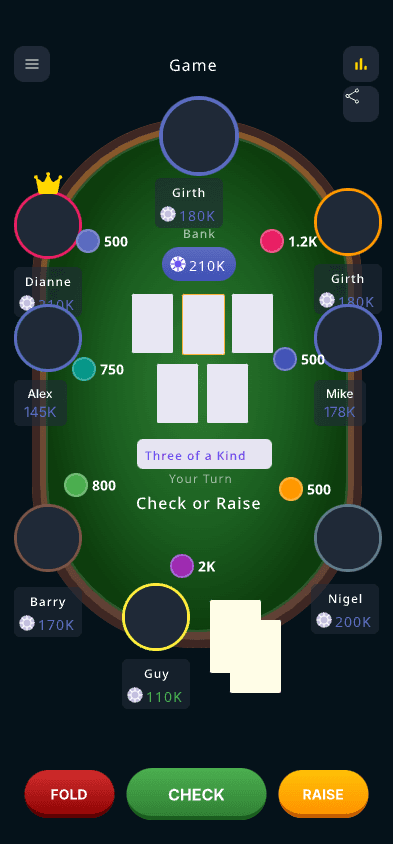
Check if your chip bank covers every player
Plan starting stacks from common denominations
Avoid slow color-ups and missing chip values
Each row is a complete setup: what the blinds should be, which colours to use, and what one player receives. The stack is sized so the smallest chip covers the small blind for a full session without anyone needing change.
Buy-in
$5
Blinds
0.05 / 0.10
Colours
White 0.05, red 0.25
Each player gets
20 white, 16 red
Stack depth
50 big blinds
Buy-in
$20
Blinds
0.10 / 0.25
Colours
White 0.10, red 0.50, green 2.50
Each player gets
20 white, 12 red, 4 green
Stack depth
80 big blinds
Buy-in
$50
Blinds
0.25 / 0.50
Colours
White 0.25, red 1, green 5, black 25
Each player gets
20 white, 15 red, 5 green, 1 black
Stack depth
100 big blinds
Planificateur de mallette
Réserve de jetons
50,000
Nécessaire
30,000
Jetons moyens
36.7
Statut
Couvert
Tapis conseillé par joueur
3 x 1,000
4 x 500
0 x 100
0 x 25
20,000 chip value remains for rebuys or color-ups.
Étape suivante
Emmenez la même configuration à une table que chacun suit sur son téléphone. Les comptes sont déjà faits.
Gratuit · sans téléchargement · connexion seulement si vous organisez
Enter the number of seats and the starting stack you want each player to receive. The calculator compares that requirement with the total value in your chip set.
Small home games usually work best with a few clear chip values. Too many denominations slow down bets, change-making, and end-of-night counting.
If your chip set cannot cover the room cleanly, create a PokerChip.live room and let every player track a digital stack from their phone.
The instinct is to look at the chip set and divide it up. Work the other way: decide the buy-in, decide how many big blinds that should be, and only then check whether your set can express it. A hundred big blinds is the standard depth for a cash game, so a $20 buy-in with a $0.10 big blind wants 200 big blinds and is probably too deep for a casual table — either raise the blinds or lower the buy-in.
A five-hundred-chip set arrives with five colours and the instinct is to use all of them. At a $20 buy-in you need three: ones, fives and twenty-fives. The fourth colour adds nothing except a chip somebody has to break in the middle of a hand, and the fifth adds a value people have to be reminded of twice a night.
This is the constraint people miss. If your small blind is 1, you need enough ones for everybody to post them for two hours without running out — roughly twenty per player. Setting a blind smaller than your smallest chip is the single most common home-game setup error, and it turns every hand into a change-making exercise.
Below twenty a stack cannot be bet in meaningful increments; above forty it stops being countable at a glance and starts falling over. The exact number matters less than the shape: plenty of the smallest denomination, a working middle, and one or two large chips that exist to be broken later rather than bet now.
Most sets are sized for the starting stacks and nothing else, and then three people rebuy. Hold a reserve of roughly one extra stack per two players, or agree in advance that rebuys are paid in larger denominations. Discovering you are out of red chips at midnight is the point at which somebody suggests using coins.
Some nights there are more players than the set was built for. Adding a colour nobody agreed on, or letting one player track their stack on paper, both end badly. The alternative is to leave the cards physical and move the chips to everyone's phone, where there is no limit on players, denominations or rebuys and nothing to count at the end.
In a tournament the smallest denomination stops mattering once the blinds climb past it, and then it is just clutter — players are counting out twelve whites to make a bet nobody cares about. Colour up at a break: everyone trades their smallest chips for the next size, and those chips leave the table. Round odd amounts up rather than making somebody change for their last one, because the goodwill costs less than the delay.
FAQ
01
Many casual home games work with 35 to 50 chips per player. The exact count depends on your denominations, blinds, starting stack, and whether rebuys are allowed.
02
Use values that match your blinds. For a 25/50 game, common values include 25, 100, 500, and 1,000.
03
Yes. For cash games, map chip values to real buy-in units. For tournaments, use the values as tournament points.
04
You can reduce the starting stack, simplify denominations, or use PokerChip.live as a digital chip tracker with real cards.
05
No. PokerChip.live tracks chips and scores only. Players settle privately outside the app.
06
Between 20 and 35 for a home game. Fewer than 20 and you cannot bet in small increments; more than 40 and the stack stops being countable at a glance.
07
Three is usually right: 1, 5 and 25. Add 100 only if the buy-in needs it. Every extra colour is another value to remember and another chip to break mid-hand.
08
Raise the blind or lower the chip value — you cannot post a blind you have no chip for, and improvising makes every hand a change-making exercise.
09
No, and trying to is what produces five-colour home games. You need a chip that covers the small blind at the level you are playing, and you colour up when the blinds pass it.
010
Around 100 big blinds is the standard for a cash game. Much deeper than that makes a casual table awkward to play; much shallower turns most hands into a shove-or-fold decision.
Create a free room, invite players, track live stacks, and share the final result when the game ends.
Create Game Room