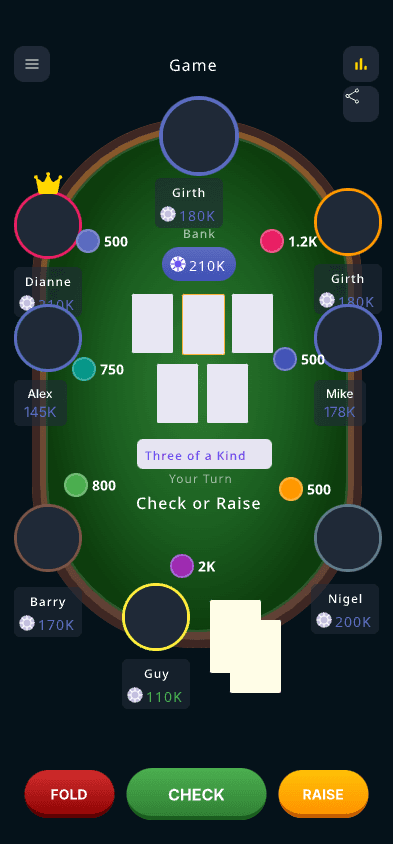
Poker Now Hand History — How to Read and Review It
A hand history is the log of what actually happened: who was in each hand, what went in the pot, and how it ended. Poker Now records one per game, and the useful part is not re-reading every hand but knowing which handful are worth looking at. This guide covers how to read the log, which hands actually teach you something, and what a home game playing with real cards can and cannot capture.
The gap is hole cards, and it is not a software limitation — cards dealt from a physical deck never touch the browser. Everything else about a hand can still be recorded.
Detail
Hole cards
Online table
Recorded
In-person with digital chips
Not captured — real deck
Detail
Community cards
Online table
Recorded
In-person with digital chips
Not captured — real deck
Detail
Position and who was dealt in
Online table
Recorded
In-person with digital chips
Recorded
Detail
Bets, raises and pot size
Online table
Recorded
In-person with digital chips
Recorded
Detail
Who won the pot and how much
Online table
Recorded
In-person with digital chips
Recorded
Detail
Buy-ins, rebuys and cash-outs
Online table
Recorded
In-person with digital chips
Recorded
Detail
Results across sessions
Online table
Per session
In-person with digital chips
Accumulated in a club
Detail
Online table
In-person with digital chips
Hole cards
Recorded
Not captured — real deck
Community cards
Recorded
Not captured — real deck
Position and who was dealt in
Recorded
Recorded
Bets, raises and pot size
Recorded
Recorded
Who won the pot and how much
Recorded
Recorded
Buy-ins, rebuys and cash-outs
Recorded
Recorded
Results across sessions
Per session
Accumulated in a club
Which hands are worth reviewing
A three-hour session is roughly 100 hands. Reviewing five of them well beats skimming all of them, and these are the five.
Pick
The three biggest pots
Why it teaches something
Most of the session's money moved here
Pick
Hands you felt unsure about
Why it teaches something
Discomfort at the time marks a real decision
Pick
Big pots you lost
Why it teaches something
Check the decision, not the outcome
Pick
Big pots you won
Why it teaches something
A win can hide a bad call — check these too
Pick
Anything you folded and regretted
Why it teaches something
Usually a positional pattern, not one hand
Pick
Why it teaches something
The three biggest pots
Most of the session's money moved here
Hands you felt unsure about
Discomfort at the time marks a real decision
Big pots you lost
Check the decision, not the outcome
Big pots you won
A win can hide a bad call — check these too
Anything you folded and regretted
Usually a positional pattern, not one hand
Players
6-8 seats
Setup
15 minutes
After game
Share results
What a hand history records
Each entry covers one hand: the players dealt in, their positions relative to the button, the actions in order across each betting round, the community cards, and the result. Read together, the sequence tells you what a player did with a given holding in a given spot — which is the only thing that makes a review worth doing at all.
Reviewing a session without re-reading it
Nobody reviews three hours of hands, and trying is why most people never review anything. Pull the three or four biggest pots and the two hands where you felt uncertain at the time. Those are where the money and the mistakes are. Everything else is small pots resolving normally and it will teach you nothing.
What to actually look for
Ask two questions per hand. First: given only what you knew at that moment, was the decision reasonable? Second: did the result change your judgement of it? Those come apart constantly — a call that was correct can lose, and a call that was terrible can win. Reviewing by outcome is worse than not reviewing, because it teaches the wrong lesson with total confidence.
Positions are where the pattern shows
Sort your interesting hands by position before drawing any conclusion. Most recurring leaks in a home game are positional — playing too many hands from early position, or folding too much on the button — and they are invisible hand by hand while being obvious the moment you group them. The hand history is the only place that grouping exists.
Hand history versus the ledger
These answer different questions and it is worth keeping them apart. The ledger says who is up and who owes what, which you need before anyone leaves. The hand history says how it happened, which only matters afterwards. If your ledger does not balance, that is a ledger problem — the hand history will not fix it.
In-person games with real cards
A physical table cannot capture hole cards, because the cards never touch the software. What PokerChip.live does record is the shape of every hand — buy-ins, blinds, bets and pot sizes as they happen, plus per-session stats across the group. That is enough to see who is playing too many pots and how the money moved, without asking anyone to enter their cards into a phone mid-hand.
Keeping records across sessions
A single night is too small a sample to conclude anything about anyone, including yourself. The value shows up over a season, which is why results that accumulate across sessions are more useful than any one detailed log. A club keeps that history in one place instead of scattered across a year of one-off rooms.
FAQ
Questions about pokernow hand history
01
What is a poker hand history?
A record of each hand played: who was dealt in, their positions, the betting actions in order, the community cards, and the outcome. It is what lets you reconstruct a decision after the fact instead of relying on memory.
02
How do I review a Poker Now session?
Do not read every hand. Pull the biggest pots and the hands you were unsure about at the time, then judge each decision on what you knew then rather than on how it turned out.
03
Should I judge a hand by whether it won?
No, and this is the most common review mistake. A correct call loses often and a bad call wins often. Judging by result teaches you to repeat whatever happened to work, which is worse than doing no review at all.
04
How many hands do I need before the stats mean anything?
Far more than one session. A home game night produces too small a sample to conclude anything about a player, including yourself, so treat single-night numbers as a story rather than evidence.
05
Can an in-person home game keep a hand history?
Not a complete one — hole cards dealt from a physical deck never reach the software. PokerChip.live records the structure of each hand instead: blinds, bets, pot sizes and who was involved, which covers most of what a home game review needs.
06
What is the difference between a hand history and a ledger?
The ledger says who owes whom and is needed before anyone goes home. The hand history says how the money moved and only matters afterwards. An unbalanced ledger is not something a hand history can resolve.
07
Is reviewing hands worth it for a casual home game?
For a few hands a session, yes — mostly for the spots that felt uncomfortable at the time. Full study tooling is aimed at online grinders playing tens of thousands of hands, and it is heavy machinery for a monthly game with friends.
Ready to run the next poker night?
Create a free room, invite players, track live stacks, and share the final result when the game ends.