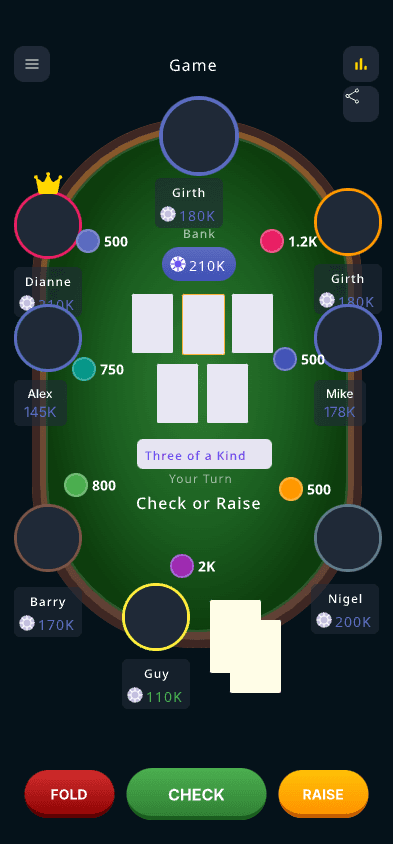
Your Poker Now game ended and the ledger shows who's up and who's down — but not who should pay whom. Enter each player's buy-in and final stack below and the calculator produces the minimum set of payments that settles everyone. It also explains the two reasons a ledger refuses to balance, and why forcing it to balance is the one thing you should never do.
Worked example — six players, five payments become three
Nets must sum to zero. Matching the biggest debtor to the biggest creditor settles this table in three transfers instead of the fifteen that pairwise settling would produce.
Player
Ana
Buy-in
$100
Cash-out
$285
Net
+$185
Settles by
Receiving from Dan and Eve
Player
Ben
Buy-in
$150
Cash-out
$210
Net
+$60
Settles by
Receiving from Eve
Player
Cal
Buy-in
$100
Cash-out
$100
Net
$0
Settles by
Nothing to do
Player
Dan
Buy-in
$100
Cash-out
$0
Net
-$100
Settles by
Pays Ana $100
Player
Eve
Buy-in
$200
Cash-out
$55
Net
-$145
Settles by
Pays Ana $85, pays Ben $60
Player
Fay
Buy-in
$100
Cash-out
$100
Net
$0
Settles by
Nothing to do
Player
Total
Buy-in
$750
Cash-out
$750
Net
$0
Settles by
3 payments
Player
Buy-in
Cash-out
Net
Settles by
Ana
$100
$285
+$185
Receiving from Dan and Eve
Ben
$150
$210
+$60
Receiving from Eve
Cal
$100
$100
$0
Nothing to do
Dan
$100
$0
-$100
Pays Ana $100
Eve
$200
$55
-$145
Pays Ana $85, pays Ben $60
Fay
$100
$100
$0
Nothing to do
Total
$750
$750
$0
3 payments
Why a ledger fails to balance
In every case the fix is to find the missing entry, not to adjust someone's number until the column sums to zero.
Symptom
Total cash-outs exceed buy-ins
Usual cause
A rebuy was never recorded
Fix
Add the rebuy to that player
Symptom
Buy-ins exceed cash-outs
Usual cause
Someone left without cashing out
Fix
Record their stack when they left
Symptom
Off by a round number
Usual cause
Cash handed over off-platform
Fix
Log it as a buy-in or transfer
Symptom
Off by a small amount
Usual cause
Chip count misread at cash-out
Fix
Recount from the chip photo if you have one
Symptom
Usual cause
Fix
Total cash-outs exceed buy-ins
A rebuy was never recorded
Add the rebuy to that player
Buy-ins exceed cash-outs
Someone left without cashing out
Record their stack when they left
Off by a round number
Cash handed over off-platform
Log it as a buy-in or transfer
Off by a small amount
Chip count misread at cash-out
Recount from the chip photo if you have one
Live calculator
Settlement calculator
Total buy-in
$400
Total cash-out
$480
Status
Check totals
Suggested payments
Blake pays Alex $60.00
Casey pays Alex $20.00
Reading the Poker Now ledger
The ledger lists each player's total buy-in and final stack; the net column is the difference. Positive nets are owed money, negative nets owe it. All nets must sum to zero — winners are paid exactly by losers, because poker moves money between players rather than creating it. If the column does not sum to zero, stop before anyone pays anything.
Settling with the fewest payments
Don't settle pairwise per pot — that produces a tangle of small transfers nobody completes. Match the biggest loser to the biggest winner, pay off whichever side zeroes out first, and repeat. That is what the calculator above does; a table of six players almost always settles in five payments or fewer, and often in three.
When the ledger doesn't balance
Two usual suspects: a rebuy recorded on one side but not the other, or a player who left mid-game without their cash-out being logged. Fix the entry rather than adjusting someone's number — a forced balance moves real money to the wrong person, and it is always the quiet player who absorbs the discrepancy.
Why the discrepancy is almost never the software
When a ledger is off, the instinct is to blame the tool. In practice the gap is a human one: a late rebuy handed over in cash, a player who topped up from someone else's stack, or a chip count read wrong at cash-out. Walking the buy-in list in order with the group takes two minutes and finds it nearly every time.
Settling across apps and cash
Most groups end up paying through a mix of transfers and cash on the table. Decide the payment list first with everyone present, then let people settle however they like — the important part is that the list is agreed before anyone leaves. A payment list written down after the fact is a negotiation, not a record.
Rounding, and the money nobody wants to move
Real ledgers produce awkward numbers, and a payment list with $3.50 in it is a list that does not get completed. Agree a rounding convention before the session — most groups round to the nearest dollar or five and let the remainder sit with the biggest winner. What matters is that the rule is set in advance, because rounding decided afterwards always looks like it favoured whoever proposed it.
When someone does not pay
The uncomfortable one. A recorded ledger agreed in front of the group is most of the answer, because the dispute becomes a fact rather than two recollections. Beyond that this is a social problem and no calculator solves it — groups that survive tend to settle before anyone leaves, and to quietly stop inviting people who make that necessary.
Playing in person next time?
PokerChip.live is the same idea for a physical table: real cards, digital chips, and the ledger builds itself — buy-ins, rebuys, and cash-outs recorded as they happen, with this settlement math run automatically at the end. The unbalanced-ledger problem largely disappears when nothing has to be reconstructed from memory.
FAQ
Questions about poker now ledger settlement
01
How do I settle a Poker Now game?
Take each player's net from the ledger (cash-out minus buy-in), then match losers to winners: the biggest debtor pays the biggest creditor until one side reaches zero, and repeat. The calculator on this page does it for you.
02
Why doesn't my Poker Now ledger balance?
Usually an unrecorded rebuy or a mid-game leaver whose stack wasn't logged. Total buy-ins must equal total cash-outs; find the missing entry instead of forcing the numbers.
03
What is the minimum number of payments to settle?
At most one fewer than the number of players with a non-zero result. Matching largest debts to largest credits usually gets close to that minimum, and the calculator above reports the list it found.
04
Should I settle the ledger before everyone leaves?
Always agree the payment list while the group is still together, even if the money moves later. Reconstructing a disputed ledger over text the next day is how home games lose players, and nobody remembers their cash-out accurately by then.
05
Does PokerChip.live work with Poker Now?
They cover different nights: Poker Now hosts remote virtual tables, PokerChip.live runs in-person games with real cards and digital chips. Many groups use both and settle with this same calculator.
06
Can I use this calculator for a game that wasn't on Poker Now?
Yes. It only needs each player's buy-in total and final stack, so it works for a pen-and-paper home game, a physical chip set, or any other tracker's export. Nothing about the maths is specific to one platform.
07
Is this settlement calculator free?
Yes. No sign-up, no download — enter buy-ins and cash-outs and the payment list appears instantly.
Ready to run the next poker night?
Create a free room, invite players, track live stacks, and share the final result when the game ends.