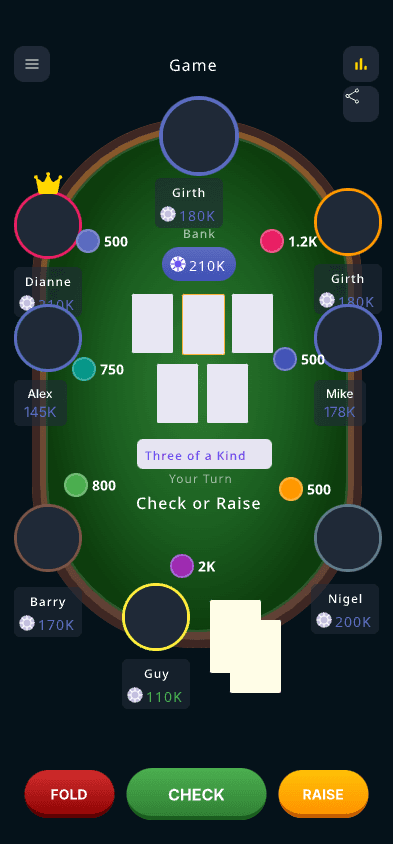
Poker Now Club Alternative — a Group That Persists Between Games
A Poker Now game is built around one session: everyone joins a link, plays, settles, and the room is done. That works fine until your group becomes a regular thing and somebody asks who is actually up over the year. A club is the missing layer — a persistent group with members, roles, and results that accumulate across every night you play. PokerChip.live clubs are free, live in the browser, and are built for a group that meets in person with real cards.
The signal is always the same question: who is actually winning over the long run? A session room cannot answer it, because each night starts from nothing and the history lives in whoever happened to screenshot the ledger. Once your group has a name and a rough schedule, you want the results to belong to the group rather than to a series of unrelated links.
What a club actually gives you
A roster you manage rather than a link you resend, roles so more than one person can run a night, results that accumulate into standings, and a privacy boundary so the group's numbers are the group's business. It also means a new player joins the club once instead of being re-invited every week, which is the part that quietly kills recurring games.
Roles: owner, admin, member
The owner controls the club and its settings. Admins can run game nights and manage the roster, which matters because the person who hosts is not always the person who set the club up — somebody else's apartment, somebody else's week. Members play and see the standings. Splitting these means a night does not stall because one person is unavailable.
Standings that come from real games
Season standings are computed from recorded buy-ins and cash-outs, not from anyone typing results into a spreadsheet afterwards. That distinction matters more than it sounds: a leaderboard nobody has to maintain is a leaderboard that still exists in March, and it is the single thing that turns a group of people who sometimes play poker into a group that has a season.
Still an in-person product
Clubs do not change what this is. Your group deals a real deck around a real table; the browser handles chips, pots, blinds and settlement. If your club plays remotely, a virtual table like Poker Now is the right tool and a club here would have nothing to record.
Why recurring games die, and what a club fixes
Regular home games rarely end because people stopped enjoying poker. They end because organising each one is unpaid work that falls on one person: chasing who is coming, resending the link, remembering the stakes, reconstructing last time's result. A club moves that load off an individual — the roster already exists, any admin can start the night, and the history is not in someone's photo roll.
What a club does not do
It does not deal cards, it does not run remote games, and it will not make a group that has stopped meeting start again. It also cannot reconstruct results from nights played before the club existed. A club is bookkeeping and roles for a group that already exists — useful, but not a substitute for someone in the group deciding to pick a date.
Getting a club started
Create the club, add the regulars, and run the next game night from it — results attach to the club automatically. The free tier includes one club, which covers almost every group; Pro removes that limit along with ads, and adds exports and deeper insights for people who want the data outside the site.
FAQ
Questions about pokernow club
01
Does Poker Now have clubs?
Poker Now is organised around game rooms for a session rather than a persistent club roster, so people searching for a club alternative are usually looking for somewhere the group and its results survive between nights.
02
Is a PokerChip.live club free?
Yes. The free tier includes one club with full member management and standings, which is enough for a single regular group. Pro lifts the club limit and removes ads if you run more than one group.
03
How many clubs can I create on the free plan?
One. That covers the common case of a single recurring home game. If you host separate groups — a work game and a friends game, say — Pro removes the limit rather than making you juggle one club.
04
What is the difference between a club and a room?
A room is one game night and ends when the game does. A club is the group itself: a roster with roles that persists, with every room played under it feeding the same standings and history.
05
Can more than one person run club game nights?
Yes. Admins can host sessions and manage members alongside the owner, so the club does not depend on one person being free every week. That is usually the reason a recurring game quietly stops.
06
Who can see our club results?
Club results are scoped to the club rather than published, so the group's numbers stay with the group. Members see the standings; the owner and admins control who is in the roster.
07
Can I move an existing group into a club?
Yes, though past sessions played in one-off rooms do not retroactively attach to it. The practical approach is to create the club now and start the standings from the next game, treating the previous results as history rather than trying to backfill numbers nobody fully remembers.
08
Do club members need accounts?
Members need an account for their results to accumulate across sessions, since that is the whole point of a club. Guests can still join an individual game night by link without registering, they just will not appear in the standings.
Ready to run the next poker night?
Create a free room, invite players, track live stacks, and share the final result when the game ends.