Free · No login required

Poker Chip Distribution Calculator

Enter your player count, buy-in, and big blind, and this calculator builds a chip distribution that actually plays well: the smallest chip covers the small blind, denominations step up in sensible ratios, and every player gets an identical stack. It also checks whether a standard 300 or 500-piece set covers the table.

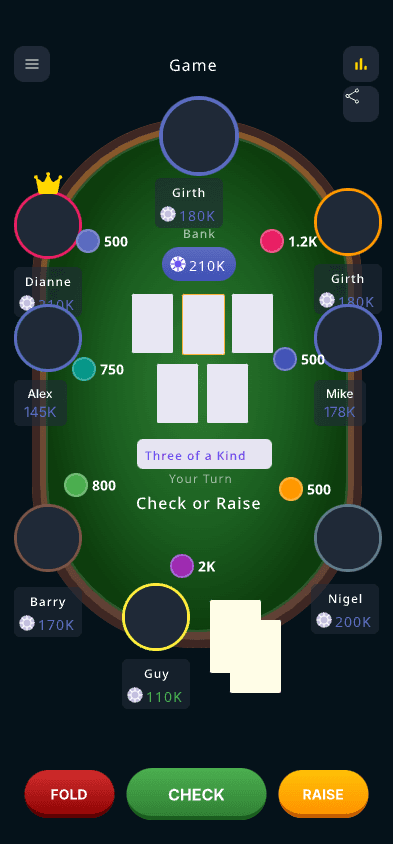
PokerChip.live digital poker table

Exact chips per player by denomination

Smallest chip always covers the small blind

Checks your chip set has enough pieces

Quick reference: chips needed by table size

Assumes roughly 40–60 chips per player, the comfortable range for cash games. Deep-stack or rebuy-heavy games trend higher.

PlayersChips neededRecommended set
2–4160–240300-piece set
5–6240–360300–500-piece set
7–8320–480500-piece set
9–10400–600500+ piece set
ChipPer playerStack valueTable total (6 players)
$0.2524 chips$6144 chips
$114 chips$1484 chips
Total38 chips$20228 chips

Suggested blinds: $0.25 / $0.50. Smallest chip equals the small blind so every bet is payable.

A standard 300-piece chip set covers this game (228 chips needed).

The 4-3-2-1 idea behind good distributions

A stack that plays well is weighted toward small chips: you want plenty of small-blind and big-blind chips for early betting, a solid band of mid chips for raises, and a few big chips to keep stacks compact. This calculator weights the buy-in toward small and mid denominations and only adds a large chip when the buy-in can absorb it.

Why the smallest chip matters most

If your smallest chip is bigger than the small blind, every hand starts with change-making. Set the smallest denomination to the small blind and the game flows without a banker.

Rebuys and the bank

Keep undistributed chips as the bank and sell rebuys from it at the same denominations. If the bank runs dry mid-game, color up: swap players' small chips for big ones and re-issue the small ones.

Skip the chip math entirely

With digital chips there is nothing to distribute: set the buy-in, players join with a code, and every stack, blind, and pot is exact automatically — including rebuys and settlement.

FAQ

Questions about poker chip distribution

01

How many chips does each player need?

40–60 chips per player is comfortable for cash games. Fewer than 30 makes betting clunky; more than 80 rarely adds value outside deep tournaments.

02

How many players can play with a 300-piece set?

Comfortably 4–6 players at 40–60 chips each. Seven or more players usually calls for a 500-piece set.

03

What denominations should a home cash game use?

Two to four denominations are enough. Start the smallest at the small blind and step up roughly 4–5x each level. For a $20 buy-in, $0.25 and $1 chips are plenty; add $5 chips once buy-ins reach $50 or more.

04

What is the difference between this and the chip stack calculator?

This page starts from your buy-in and blinds and designs the distribution. The chip stack calculator starts from the chips you own and checks coverage. Use whichever matches what is fixed for your game.

05

Does this work for tournaments?

It is tuned for cash games. For tournaments, use T25/T100/T500/T1000 values with a 5,000 starting stack and pair it with the blinds calculator and tournament timer.

Ready to run the next poker night?

Create a free room, invite players, track live stacks, and share the final result when the game ends.

Create Game Room