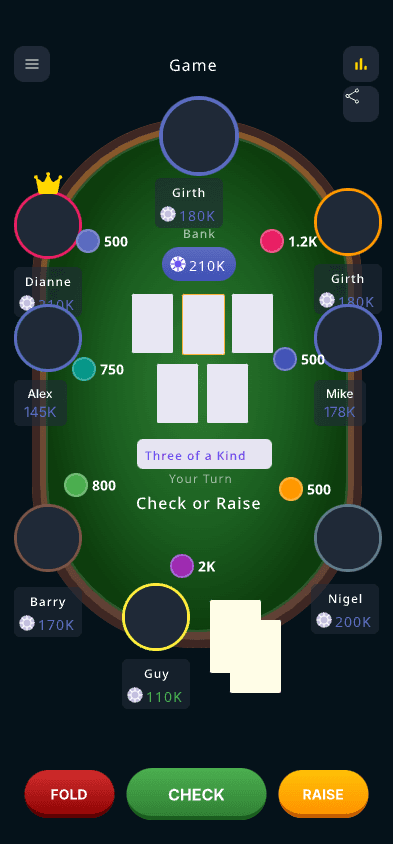
Setting blinds is the part of hosting that decides whether your tournament finishes on time or drags past midnight, and it is also the part people most often hit a paywall on. The calculator below builds a full blind schedule for free: starting stack, level durations, and the progression of small blind, big blind and antes. It works for a Poker Now game, a physical chip set, or a PokerChip.live room, because a blind structure is just a schedule — it does not belong to any platform.
Eight levels of 15 minutes, roughly doubling each level, with a big-blind ante from level 5. Copy it as-is or use the calculator above to build one for a different length of night.
Level
1
Small blind
25
Big blind
50
Ante
—
Duration
15 min
Level
2
Small blind
50
Big blind
100
Ante
—
Duration
15 min
Level
3
Small blind
75
Big blind
150
Ante
—
Duration
15 min
Level
4
Small blind
100
Big blind
200
Ante
—
Duration
15 min
Level
5
Small blind
150
Big blind
300
Ante
300
Duration
15 min
Level
6
Small blind
200
Big blind
400
Ante
400
Duration
15 min
Level
7
Small blind
300
Big blind
600
Ante
600
Duration
15 min
Level
8
Small blind
500
Big blind
1,000
Ante
1,000
Duration
15 min
Level
Small blind
Big blind
Ante
Duration
1
25
50
—
15 min
2
50
100
—
15 min
3
75
150
—
15 min
4
100
200
—
15 min
5
150
300
300
15 min
6
200
400
400
15 min
7
300
600
600
15 min
8
500
1,000
1,000
15 min
Picking level length by how long you have
Work backwards from the finish time rather than picking blinds first. Deeper stacks buy more playing time without shortening the levels.
Night length
2 hours
Level duration
15 min
Levels needed
8
Starting stack
5,000
Night length
3 hours
Level duration
20 min
Levels needed
9
Starting stack
5,000
Night length
4 hours
Level duration
20 min
Levels needed
12
Starting stack
10,000
Night length
Casual, no fixed end
Level duration
20 min
Levels needed
12+
Starting stack
10,000
Night length
Level duration
Levels needed
Starting stack
2 hours
15 min
8
5,000
3 hours
20 min
9
5,000
4 hours
20 min
12
10,000
Casual, no fixed end
20 min
12+
10,000
Structure builder
Blind schedule
Level 10-15 min25/50
Level 215-30 min40/75
Level 330-45 min55/115
Level 445-60 min85/170
Level 560-75 min125/255
Level 675-90 min190/380
Level 790-105 min285/570
Level 8105-120 min425/855
Blind structure is a schedule, not a feature
A structure is a list: level number, small blind, big blind, ante, and how long the level lasts. Nothing about it is proprietary to any site. Generate the schedule here, then enter the values wherever your game actually runs — a paid tier is not required to decide that level four is 100/200.
Start from the length of the night
Work backwards from when you want to finish. Two hours means roughly eight levels of fifteen minutes; three hours means twenty-minute levels with a gentler climb; four hours means either more levels or a deeper starting stack. Picking blinds first and hoping the night lands correctly is how tournaments end at one in the morning with three exhausted players.
Starting stack and the 100 big blind rule
Give every player about 100 big blinds to start. With a 5,000 chip stack that means opening at 25/50. Deeper than 100 big blinds and the early levels are slow; much shallower and the tournament is decided by whoever picks up a hand first, which is a coin flip wearing a poker game's clothes.
How fast blinds should climb
Roughly doubling each level makes a fast, decisive night. Multiplying by about 1.5 keeps stacks playable for longer and suits a group that wants to actually play rather than shove. Whatever you choose, keep the ratio consistent — a structure that jumps unevenly punishes whoever happens to be in the blinds at the jump.
When to add antes
Add an ante once players start folding every hand to preserve their stack, usually around level four or five. A big-blind ante is simplest at a home game because only one player posts it each hand, so nobody has to count out small chips every deal.
If the night runs long
Stop raising and repeat the current level, or agree a hard finish time and pay out by chip count. Do not accelerate the structure mid-game to force an ending — that hands the win to whoever happened to be ahead when the rules changed, and everyone at the table knows it.
Running it at a real table
If your group plays in person, PokerChip.live runs the blind schedule alongside the chips: the timer advances the level, every player's phone shows the current blinds, and the pot and settlement are tracked as you go. Real cards on the table, no app install, no paid tier for any of it.
FAQ
Questions about poker now blinds
01
How do I change blinds on Poker Now without paying?
The blind values themselves are just numbers you enter when configuring a game — use the calculator on this page to work out the schedule, then apply it. If a feature you need is genuinely behind a paid tier, a free browser tool like PokerChip.live runs the same structure at no cost.
02
What blinds should I start with?
Start where each player has about 100 big blinds. A 5,000 chip starting stack means opening at 25/50; a 10,000 stack means 50/100. Scale both together rather than picking blinds in isolation.
03
How long should each blind level last?
Fifteen to twenty minutes for a casual home tournament. Ten minutes makes for a fast night, and anything shorter turns the game into a shove-fest where stack size stops mattering.
04
How many blind levels do I need?
Divide the length of the night by your level duration — about eight levels for two hours at fifteen minutes each, twelve for three hours at twenty. Generate a couple more than you need so the game never runs out of schedule.
05
Should blinds increase in a cash game?
No. Cash games keep blinds fixed so players can buy in and cash out at any point without the stakes shifting under them. Rising blinds are a tournament mechanism for forcing an ending.
06
When should I add antes to the structure?
Around level four or five, once the blinds are large enough that players are folding to preserve their stacks. A big-blind ante keeps it simple because only one player posts it per hand.
07
What starting stack should I give rebuys?
The same stack everyone started with, not a stack scaled to the current blind level. Anything else either punishes the rebuying player or hands them an advantage, and both versions cause arguments. Decide when the rebuy period closes at the same time you set the structure.
08
Can I use this structure with a physical chip set?
Yes. A blind schedule is platform-independent — the only extra consideration is that your chip denominations need to cover the later levels, so plan a color-up at a break rather than letting people stack forty small chips.
Ready to run the next poker night?
Create a free room, invite players, track live stacks, and share the final result when the game ends.