Use a visible clock
Players should know when the next blind increase is coming. A visible timer avoids confusion and keeps the night on schedule.
Keep the tournament moving
A tournament timer keeps players aligned on level changes. Use this free clock with your PokerChip.live room for small home tournaments.
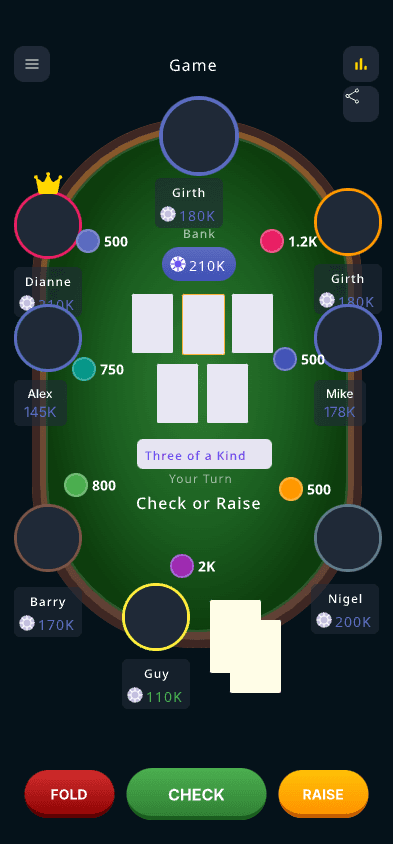
Countdown for blind levels
Simple level progression
Works alongside digital chip tracking
Twenty-minute levels, doubling roughly every two levels, with a break where the colour-up happens. Adjust the level length rather than the blind jumps if you need a longer or shorter night — changing the jumps is what turns a tournament into a coin flip.
Level
1
Small blind
25
Big blind
50
Ante
—
Notes
20 min
Level
2
Small blind
50
Big blind
100
Ante
—
Notes
Level
3
Small blind
75
Big blind
150
Ante
—
Notes
Level
4
Small blind
100
Big blind
200
Ante
25
Notes
Break, colour up the 25s
Level
5
Small blind
150
Big blind
300
Ante
50
Notes
Level
6
Small blind
200
Big blind
400
Ante
50
Notes
Level
7
Small blind
300
Big blind
600
Ante
75
Notes
Usually the final table
Level
8
Small blind
500
Big blind
1,000
Ante
100
Notes
Level
9
Small blind
700
Big blind
1,400
Ante
200
Notes
Heads-up by here
Starting stack of 10,000 with eight players. Level length is the dial to turn when you need a different night; the blind jumps are not.
Level length
10 minutes
Runs about
1.5 hours
Feels like
A turbo — mostly shove-or-fold by the middle
Level length
15 minutes
Runs about
2 to 2.5 hours
Feels like
Brisk, still playable, good for a weeknight
Level length
20 minutes
Runs about
3 hours
Feels like
The standard home structure
Level length
30 minutes
Runs about
4.5 hours
Feels like
Deep, and longer than most groups want
Horloge de tournoi
Blinds 25/50
Players should know when the next blind increase is coming. A visible timer avoids confusion and keeps the night on schedule.
Agree on level length before the first hand. Changing the pace mid-game can feel unfair.
The timer handles tournament rhythm while PokerChip.live tracks player stacks and game flow.
The blinds structure sets the shape of the tournament; the level length sets the clock. Twenty minutes a level with a 10,000 starting stack runs about three hours with eight players. If you need it shorter, cut the level to fifteen minutes before you touch the blind jumps — steepening the jumps makes the tournament shorter by making it more random, which is not the same thing.
A timer on the host's phone in their pocket is not a timer. Blinds go up when somebody remembers, which means they go up late for whoever is short and on time for whoever is not. Put the clock somewhere the whole table can see it — a laptop, a tablet propped up, a phone leaning against the chip case — and the arguments about whether the level already changed disappear.
The convention is to say the new blinds out loud when the clock passes, and to finish the hand in progress at the old level. Both halves matter. Raising blinds mid-hand is the single most common source of a disputed pot in a home tournament, and the fix costs nothing.
Adding an ante puts money in the pot before anyone acts, which makes stealing profitable and forces the action. Most home games introduce them too late, around the point where half the field is already out. Starting them around level four keeps the tournament moving through the middle stages, which is where three-hour tournaments turn into five-hour ones.
A ten-minute break at level four is where people get food, and it is also the only sensible moment to colour up the small denominations. Doing both at once means the game stops once instead of twice. Pause the clock — a break that runs while the timer does is a break nobody enjoys.
A blind structure that reaches 1,400 needs chips that can express 1,400 without a player stacking fourteen hundreds. Check the top level against your chip set before the first hand, not at level eight when somebody is trying to pay a big blind in twenty-fives.
If your tournament allows rebuys, they almost always end at a fixed point — commonly after level four or at the first break. That deadline needs announcing as loudly as a blind change, because the last rebuy level is when people decide whether to gamble, and a player who missed the cut-off because nobody said anything has a legitimate complaint.
FAQ
01
It is a clock that counts down each blind level and tells players when blinds increase.
02
Most home tournaments need enough levels for stacks to become short over the planned game length. Start with 8 to 12 levels for a small night.
03
Yes. The page timer includes start, pause, and reset controls.
04
PokerChip.live supports poker rooms and blind setup. This timer page is a lightweight companion for tournament pacing.
05
For longer home tournaments, add short breaks every 60 to 90 minutes.
06
Fifteen to twenty minutes for a home game. Twenty-minute levels with a 10,000 stack and eight players runs about three hours.
07
On the clock, announced out loud, with the hand in progress finished at the old level. Raising mid-hand is the most common cause of a disputed pot.
08
Around level four. Antes force action and keep the middle stages moving; adding them late is why a three-hour tournament becomes a five-hour one.
09
You can, but it has to be visible to the whole table. A timer in the host's pocket means the blinds go up whenever someone remembers.
010
Yes. A break that runs while the clock does is a break nobody enjoys, and it quietly shortens the level people come back to.
011
Commonly after level four or at the first break. Whenever you pick, announce it as loudly as a blind change — that deadline changes how people play.
012
10,000 with 25/50 blinds is a common default. The absolute number does not matter; what matters is that it is 200 big blinds and the structure has room to climb.
Create a free room, invite players, track live stacks, and share the final result when the game ends.
Create Game Room