Start the room before players arrive
Hosts can prepare buy-ins, blinds, and player limits, then share the room code when everyone sits down.
For hosts and regular groups
Home poker games need more than a timer or a note sheet. PokerChip.live gives hosts a simple way to start rooms, invite players, track chips, and settle results.
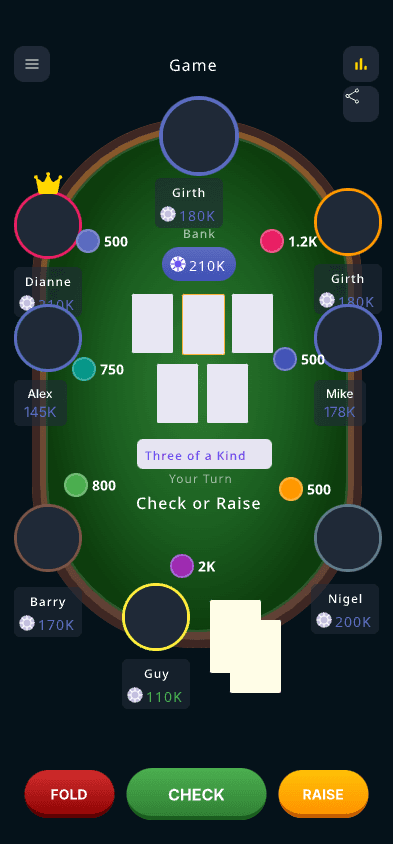
Create rooms for casual nights or regular groups
Keep every player aligned on stacks and blinds
Use results and stats to make recurring games more fun
Four numbers per player per night is enough to produce everything a group actually argues about. This is one month of a weekly game.
Player
Alex
Sessions
4
Bought in
400
Cashed out
615
Net
+215
Player
Sam
Sessions
4
Bought in
500
Cashed out
430
Net
−70
Player
Jordan
Sessions
3
Bought in
300
Cashed out
245
Net
−55
Player
Riley
Sessions
4
Bought in
400
Cashed out
310
Net
−90
Player
Total
Sessions
15
Bought in
1,600
Cashed out
1,600
Net
0
Groups usually start by tracking profit and then discover it was the wrong number. This is what each one answers.
Metric
Total profit
Answers
Who is up overall
Misleads when
Someone has played twice as many sessions
Metric
Profit per session
Answers
Who is actually winning
Misleads when
The sample is under about 20 sessions
Metric
Biggest win
Answers
Nothing useful
Misleads when
Always — it is a story, not a statistic
Metric
Sessions played
Answers
Who keeps the game alive
Misleads when
Never; it is worth knowing
Metric
Buy-ins vs cash-outs
Answers
Whether the record is correct
Misleads when
Never; it should always balance to zero
Hosts can prepare buy-ins, blinds, and player limits, then share the room code when everyone sits down.
The tracker stays focused on the logistics that slow down home games: chip counts, pot math, seat state, and settlement.
Shared results, standings, and club history create small competitive loops for regular poker nights.
Money does not appear at a poker table. If the buy-ins and the cash-outs do not sum to the same number, something was recorded wrong — an unlogged rebuy, usually. A tracker that lets the two sides drift apart is not tracking; it is taking notes. Checking that they balance at the end of every night catches the error while people are still in the room.
Not at the end. Rebuys happen late, often, and at the least convenient moment, and they are the single most common cause of a settlement that will not reconcile. Somebody hands over twenty pounds during a hand and it is genuinely gone from the record ten minutes later.
Running totals since forever stop meaning anything after a while — a player who ran badly a year ago is still carrying it in the numbers. Groups that keep a game going for years tend to reset quarterly or annually, which gives the standings stakes again and lets somebody new join without starting from behind.
Total profit rewards whoever showed up most. Per-session average is the number that answers who is actually winning, and it is the only one worth putting on a leaderboard if you want the leaderboard to be about poker rather than about attendance.
The point of failure for every home-game record is the moment where entering data is more effort than remembering it. If logging a rebuy takes more than a few seconds, it will not be logged. This is why paper spreadsheets get abandoned around session four and why the entry flow matters more than the analysis.
Most groups discover, once they have three months of data, that their view of who wins was wrong — usually because the loudest player is not the winning one. That is uncomfortable and it is also the main reason a home game gets better: people who can see their own results tend to change how they play.
One person entering everything is a single point of failure — they miss a rebuy while playing a hand, and the night does not reconcile. A tool where each player can enter their own rebuy spreads the load and, more importantly, means the person handing over money is the person recording it, which is the only arrangement that reliably stays accurate.
FAQ
01
It is for hosts, private clubs, friend groups, and recurring poker nights that want easier tracking.
02
Yes, but PokerChip.live is designed so every player can also join and follow the shared state.
03
PokerChip.live includes club and statistics features for groups that play repeatedly.
04
No. It helps track chips and game state while your group still handles cards and dealing.
05
Yes. Completed games can produce shareable result pages and images.
06
Buy-ins, rebuys, cash-outs and the date. Everything else — win rate, hourly, season standings — is derived from those four.
07
Almost always an unlogged rebuy. Money does not appear at a poker table, so if the two sides differ, something was recorded wrong that night.
08
Per session. Total profit mostly measures who showed up most often, which makes for a leaderboard about attendance rather than poker.
09
A quarter or a year. Running totals since forever stop meaning anything, and a reset lets somebody new join without starting from behind.
010
Each player entering their own rebuy is more accurate than one host entering everyone's, because the person handing over money is the one recording it.
011
Around twenty. Below that, per-session results are mostly variance and a leaderboard is a story rather than a measurement.
012
It should, if you play in more than one. Separate clubs with separate standings keeps a Tuesday game from contaminating a Friday one.
Create a free room, invite players, track live stacks, and share the final result when the game ends.
Create Game Room