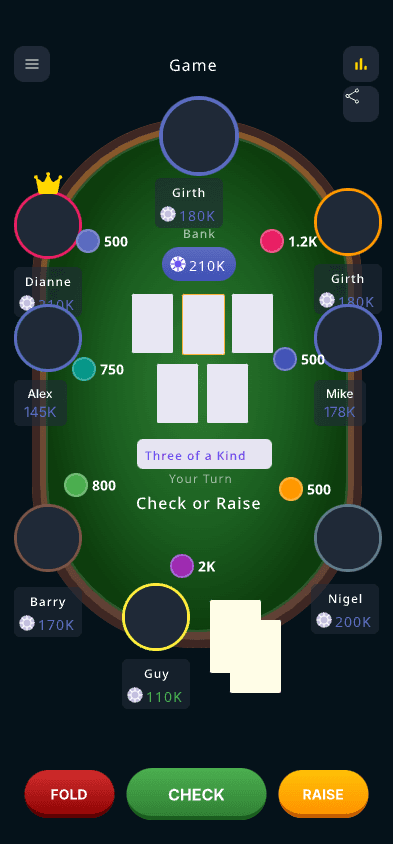
A buy-in is the amount you hand over to get chips. That is the whole definition — the money stops being money and becomes a stack, and from that moment the chips are all you can lose in the game and all you can bet with. Everything else people mean by the word is a detail hanging off that one idea: a cash game has a minimum and a maximum buy-in, a tournament prints its buy-in as two numbers added together, and a home game usually just agrees on one figure and repeats it. The part that actually causes arguments is none of those. It is that at the end of the night the buy-ins have to add up to the cash-outs, and at most kitchen tables nobody wrote them down.
The figures are conventions, not rules — a home game can do whatever the table agrees on. What changes between rows is whether the buy-in is a range or a fixed ticket, and whether you can add to it later.
Game
Home cash game
Typical buy-in
$20-$100, one agreed figure
In big blinds
40-100 BB
Can you add to it?
Yes, usually any time you are not in a hand
Game
Casino no-limit cash
Typical buy-in
Table minimum to table maximum
In big blinds
20-100 BB
Can you add to it?
Yes, up to the table maximum
Game
Deep-stack cash
Typical buy-in
Higher cap, sometimes uncapped
In big blinds
200 BB+
Can you add to it?
Yes
Game
Home tournament
Typical buy-in
One fixed amount, everyone the same
In big blinds
Fixed starting stack
Can you add to it?
Only during a rebuy period, if you run one
Game
Casino tournament
Typical buy-in
Printed as "$100 + $20"
In big blinds
Fixed starting stack
Can you add to it?
Rebuy and add-on events only
Game
Typical buy-in
In big blinds
Can you add to it?
Home cash game
$20-$100, one agreed figure
40-100 BB
Yes, usually any time you are not in a hand
Casino no-limit cash
Table minimum to table maximum
20-100 BB
Yes, up to the table maximum
Deep-stack cash
Higher cap, sometimes uncapped
200 BB+
Yes
Home tournament
One fixed amount, everyone the same
Fixed starting stack
Only during a rebuy period, if you run one
Casino tournament
Printed as "$100 + $20"
Fixed starting stack
Rebuy and add-on events only
A $50 buy-in, turned into chips
One workable way to split a $50 stack for $0.25/$0.50 blinds — 100 big blinds, 41 chips, and enough small denominations to post a blind without breaking a green every orbit.
Chip colour
White
Value
$0.25
Count
20
Total
$5.00
Chip colour
Red
Value
$1
Count
15
Total
$15.00
Chip colour
Green
Value
$5
Count
6
Total
$30.00
Chip colour
Value
Count
41 chips
Total
$50.00
Chip colour
Value
Count
Total
White
$0.25
20
$5.00
Red
$1
15
$15.00
Green
$5
6
$30.00
41 chips
$50.00
Players
6-8 seats
Setup
15 minutes
After game
Share results
What a buy-in actually is
You put money in, you get chips out, and the chips are now the game. The exchange rate is fixed and public — everyone at the table buys at the same rate, which is what makes the chips mean anything. A $50 buy-in does not entitle you to $50 of anything at the end; it entitles you to whatever your stack is worth when you stand up, which may be nothing. The word covers both the act and the amount, so "my buy-in was fifty" and "I bought in for fifty" are the same sentence.
Why a cash game has a minimum and a maximum
The minimum stops someone sitting down with two big blinds, shoving every hand, and turning a skill game into a coin flip they can leave after one spin. The maximum stops one player covering the table so heavily that everyone else is playing for their whole stack every time that player raises. Most no-limit games settle on 20 big blinds minimum and 100 maximum, which keeps stacks close enough that a hand can be played in more than one street. A home game rarely needs both — agreeing on a single figure everyone buys in for does the same job more simply.
Tournament buy-ins and the number after the plus
A tournament advertised as "$100 + $20" costs $120. The $100 goes into the prize pool and comes back out to whoever finishes in the money; the $20 is the house fee for running the thing — dealers, room, clock. Only the first number is prize money, which is why comparing tournaments means comparing the split and not the headline. A home game has no second number, or rather its second number is zero, because nobody is being paid to run it. If you do take a cut to cover food, say so before people pay, not after.
Rebuys, add-ons and topping up
These three words describe three different moments. Topping up is adding to a stack that still has chips in it — normal in a cash game, allowed between hands, capped at the table maximum. A rebuy is buying in again after busting, which in a cash game is just sitting back down and in a tournament is only possible if the structure has a rebuy period. An add-on is a one-time extra stack offered at the end of that period, taken whether or not you busted. In a freezeout tournament none of the three exist: one buy-in, and when it is gone you are out.
The number that has to balance
Total buy-ins equal total cash-outs. Always, in every game, with no exceptions — the money in the middle is only ever the money the players put there. This is the single most useful fact about buy-ins and the one home games routinely fail to check. If eight people bought in for $50 each, $400 left the wallets and $400 has to go back into them; if the cash-outs add to $385, somebody miscounted a stack, and if they add to $415, somebody bought in twice and forgot to mention it. The chips on the table cannot tell you which, because both look identical at 1am.
Picking a number for a home game
Pick the amount the least comfortable player at the table would shrug at losing, then use that. The right buy-in is not the one that makes the game exciting; it is the one that keeps everybody playing their normal game for four hours instead of folding for three and gambling in the fourth. A useful check: if the buy-in is more than someone would spend on dinner out, it will change how they play, and probably how they feel about being invited back. Twenty to fifty dollars covers most kitchen tables. Set the blinds afterwards so the buy-in is 50 to 100 big blinds.
Short buying, and why regulars mind
Buying in for the table minimum, doubling up, and leaving is legal in almost every cash game and unpopular in all of them. The complaint is not that it wins money — over time it does not, much — but that a short stack removes the later streets from the hand. With twenty big blinds there is no turn decision worth having; the money goes in preflop or on the flop, and everyone else's post-flop skill stops mattering. Most home games solve this socially rather than with a rule, and a fixed buy-in for everyone solves it before it comes up.
FAQ
Questions about poker buy in
01
What does buy-in mean in poker?
The buy-in is the money you exchange for chips in order to join a game. It is both the act of joining and the amount — "the buy-in is $50" and "I bought in for $50" describe the same thing. Once exchanged, the chips are the only thing you can bet and the most you can lose in that session.
02
How much should a home game buy-in be?
Enough that the game matters and little enough that the most cautious player at the table plays normally. Twenty to fifty dollars suits most kitchen tables. Set it first, then choose blinds that make the buy-in worth 50 to 100 big blinds, which gives everyone room to play a hand past the flop.
03
What does $100 + $20 mean on a tournament?
It costs $120 to enter. The $100 goes into the prize pool and is paid back out to the players who finish in the money. The $20 is the fee the house keeps for running the event. Only the first number is prize money, so it is the one to compare between tournaments.
04
What is the difference between a buy-in and a rebuy?
A buy-in is your first entry. A rebuy is buying in again after losing your stack. Topping up is different from both — that is adding chips to a stack you still have, which cash games allow between hands and tournaments generally do not.
05
Do you get your buy-in back at the end?
Only if your stack is still worth it. You cash out whatever chips you are holding when you leave, which may be more than you bought in for, less, or nothing at all. The buy-in is not a deposit and there is no floor under it.
06
Can you add chips in the middle of a hand?
No. Under table stakes you play a hand with the chips that were in front of you when it started, and you cannot reach into your pocket for more once cards are out. That rule is why side pots exist. You can top up freely between hands, up to the table maximum.
07
Why do the buy-ins and cash-outs have to match?
Because the only money in the game is the money players brought. If eight people buy in for $50 each, exactly $400 must be paid back out. A total that does not match means a miscounted stack or an unrecorded buy-in, and the chips on the table cannot tell you which one it was.
Ready to run the next poker night?
Create a free room, invite players, track live stacks, and share the final result when the game ends.