Poker Pot Odds Calculator — Is This Call Profitable?
Pot odds are the price the pot is offering you. If you have to put in 100 to win 300, you need to win that pot more than a third of the time for the call to make money — and everything else is detail. The calculator above takes the pot, the amount you have to call and how many outs you have, and tells you whether the call is profitable on odds alone. It uses exact card-counting rather than the rule of 4 and 2, which drifts badly on big draws.
Bet size is described relative to the pot before the bet went in. The equity column is what you need to win for a call to break even.
Their bet
Quarter pot
Pot when it reaches you
125
You call
25
Equity needed
20.0%
Their bet
Third pot
Pot when it reaches you
133
You call
33
Equity needed
24.8%
Their bet
Half pot
Pot when it reaches you
150
You call
50
Equity needed
25.0%
Their bet
Two-thirds pot
Pot when it reaches you
167
You call
67
Equity needed
28.6%
Their bet
Pot
Pot when it reaches you
200
You call
100
Equity needed
33.3%
Their bet
Overbet, 1.5x pot
Pot when it reaches you
250
You call
150
Equity needed
37.5%
Their bet
All in, 2x pot
Pot when it reaches you
300
You call
200
Equity needed
40.0%
Their bet
Pot when it reaches you
You call
Equity needed
Quarter pot
125
25
20.0%
Third pot
133
33
24.8%
Half pot
150
50
25.0%
Two-thirds pot
167
67
28.6%
Pot
200
100
33.3%
Overbet, 1.5x pot
250
150
37.5%
All in, 2x pot
300
200
40.0%
Odds del bote
¿Sale rentable pagar?
Odds del bote2:1
Equity que necesitas33.3%para ganar 300
Equity que tienes35.0%regla del 4 y 2: 36%
Paga. Vas 1.6 puntos por encima del precio.
What pot odds actually mean
You are being offered a price. The pot contains a certain amount, you must add a certain amount, and if you win you take all of it. Break-even is when the amount you risk, as a share of the final pot, equals how often you win. Below that share, calling loses money over time even when it wins tonight — and tonight is not the timeframe that matters.
Counting your outs honestly
An out is a card that gives you the best hand, not a card that improves your hand. Nine outs to a flush is only nine outs if the flush wins when it comes; if the board is paired and someone is representing a full house, some of those cards make you a second-best hand you will pay off with. Overcounting outs is the most common way this calculation goes wrong, and it always errs toward calling.
Why the rule of 4 and 2 is not enough
Multiply outs by four with two cards to come, by two with one card. It is close for small draws — a gutshot is 16% and the rule says 16. It breaks down as outs grow, because the shortcut ignores that hitting on the turn removes a card. At fifteen outs the rule claims 60% and the truth is 54.1%, which is exactly the size of draw where a big bet forces the decision.
Implied odds, and when to call anyway
Pot odds only count the money already out there. Implied odds account for what you expect to win on later streets if you hit. A flush draw getting a slightly bad price is often still a call against an opponent who will pay you off on the river, and often a clear fold against one who shuts down the moment a third suit lands. This calculator deliberately does not guess at that — it gives you the price, and the read is yours.
Reverse implied odds cut the other way
The mirror of implied odds, and the one people forget. If the card that completes your hand also completes a better one for someone else — the low end of a straight, a flush when you hold the smallest of the suit — then hitting can cost you more than missing. When your draw is to the weak end of something, shade the price you need upward.
Doing this at a real table
Nobody is opening a calculator mid-hand, and you should not want to. Use this away from the table until the common spots are memorized: a flush draw needs about 35% from the flop and 20% from the turn, an open-ender about 31% and 17%, a gutshot about 16% and 9%. Those six numbers cover most decisions you will face at a home game.
Where the chips are tracked
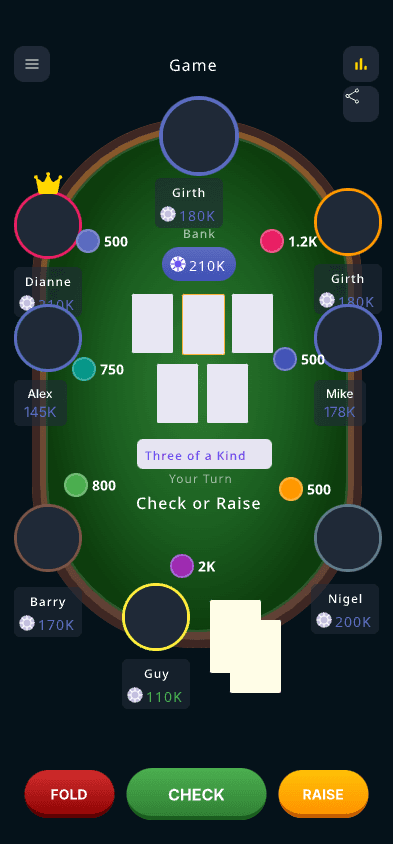
Knowing the price only helps if the pot size is right, and at a home game with physical chips it frequently is not — someone miscounts, a side pot gets muddled, and the number you are pricing against is wrong. PokerChip.live keeps the pot and side pots exact on every player's phone while you deal real cards, so the odds you calculate are the odds you are actually getting.
FAQ
Preguntas sobre poker pot odds calculator
01
How do you calculate pot odds in poker?
Divide the amount you must call by the total pot after your call. Calling 100 into a pot that already holds 200 means 100 divided by 300, so you need to win about 33% of the time to break even.
02
What equity do I need to call a pot-sized bet?
About 33%. A pot-sized bet means the pot on the table is twice what it was, so you are risking one unit to win three. Anything above a third of the time makes the call profitable on odds alone.
03
Is the rule of 4 and 2 accurate?
Close for small draws, and increasingly wrong as outs grow. At four outs it is almost exact; at fifteen outs it claims 60% against a true 54.1%. That is a big enough gap to turn a marginal call into a losing one.
04
What is the difference between pot odds and equity?
Pot odds are the price the pot offers you. Equity is how often you win. Calling is profitable on odds alone when your equity is higher than the share of the pot you are putting in.
05
Should I ever call without the right pot odds?
Yes, when implied odds justify it — a draw that will win a large pot later can be worth a slightly bad price now. That depends entirely on whether your opponent will pay you off, which no calculator can tell you.
06
How many outs does a flush draw have?
Nine, since there are thirteen cards of each suit and you can see four of them. That is about 35% to come in from the flop and about 20% from the turn.
07
Do I count outs that give someone else a better hand?
No. An out is a card that wins the pot, not one that improves your hand. Cards that make you a second-best hand you will then pay off with are worse than blanks.
¿Listo para la próxima noche de póker?
Crea una sala gratis, invita jugadores, sigue los stacks en vivo y comparte el resultado final.